Thursday, October 18, 2012

Please Sir, may I have some MORE!

First, sorry for being a bit late with this posting, but it has been a busy week here at Harlaxton. Among other things, yours truly participated in the annual Harlaxton Variety Show last evening along with about a dozen students, as well as three children of visiting faculty here for the term. It was a grand evening, music, comedy, dancing, etc., held in the Great Hall. We did a couple of John McCutcheon tunes that were very well received (if we do say so ourselves).

Anyway, on Tuesday, the entire school was taken over to The Southwell Union Workhouse, a particularly stark reminder of the official attitudes of the Victorians to those less fortunate members of society who had no job or were in some way prevented from working--age, disability, an economic downturn, things like that. If you have ever read Dickens, watched "A Christmas Carol" on TV,  or seen the musical "Oliver" you will know what I am talking about.

Southwell was actually built in 1824, a decade before the passage of the new Poor Law, ("You're poor, boy. That's why we have poor laws in the country!") which completely revamped the way those in need were to be handled. Its setup was used as a model for the "reform" measure passed in1834. Since the last poor laws had been set up in 1601 when Good Queen Bess was still on throne more than 230 years before, we're thinking that it was probably time for a little tinkering, wouldn't you?

From the outside the facility looks pretty solid and imposing, but not particularly odious.


But behind those walls, there was a whole system of treatment designed to make life in the workhouse so odious  and distasteful that people would do literally anything to avoid having to come to the workhouse.

To understand the system however, you need to know that the Victorians charitably made a distinction between the "deserving" and the "undeserving" poor. The deserving poor were those who through no fault of their own--old age, disability, widowhood, abandoned children--were forced to seek assistance from the state. The undeserving poor were any able-bodied man, woman, or teenage child who couldn't find work. Poverty for these people was seen as a moral failing, i.e. the fact that they had no job was the result of the fact that they just would not go out and get a job because they were no-good layabouts who were just waiting for the benefits to roll in. Unfortunately, there are those in America today who seem to have about the same opinion. Amazing, sometimes, to think how far we have NOT come. Economic conditions--downturns, depressions, bank panics, etc. (financial meltdowns brought on by toxic lending practices)--were never excuses for not having a job.

So, as I said,  the whole point behind the Poor Law of 1834, then, was to make public assistance so odious and distasteful that people would do virtually anything to avoid going to the Workhouse, that public assistance was to be the very LAST option. For example, workhouses were strictly segregated by sex, i.e. men and women--even if married--were forced to live in separate parts of the workhouse. Children were placed in another area away from both their parents. If you were able-bodied, you worked and menial tasks all day or even and tasks that had no point at all except to keep you busy, i.e. like an army fatigue. Rules were strictly enforced.


This particular workhouse could handle up to about 160 people for which there was one privy for each sex--a hole in the ground--and one water pump for each sex in their respective workyards.


The chap holding the clipboard was our guide from the National Trust. He often does this in costume as one of the inmates (and I use that term deliberately as these places were very little better than prisons). Suffice it to say that it was a very sobering experience for the students and your faithful blogster. Also, admittedly a great treat as we are a scholar of the Victorian Era and knew a fair amount about the workhouse system but had never visited one. If you want additional info on this whole era, check out Edwin Chadwick's Poor Law Report to Parliament in 1834, or Friedrich Engels (yes, that Engels) Condition of the English Working Class published in 1844. Or, just read more Dickens!

Saturday, October 13, 2012

A Horse, A Horse. . .

Well, today campers, we visited the city of Leicester about an hour's train ride from here to the west and south. It is famous for several things, but most importantly for being the final resting place of wicked King Richard III, he of the hunchback and the little Princes in the Tower--yes, yes, I know, all Tudor propaganda designed to clear Henry VII of murdering the little darlings. Not buying it. Richard put the princes in the Tower, his own nephews no less, and nobody ever heard of them again. Both of them had precedence over Richard for the throne so he needed them dead. Not that Henry would have balked at a little murder if he'd found them still alive in the Tower when he got to London, and from the same motive as Richard, but that is stretching it methinks.

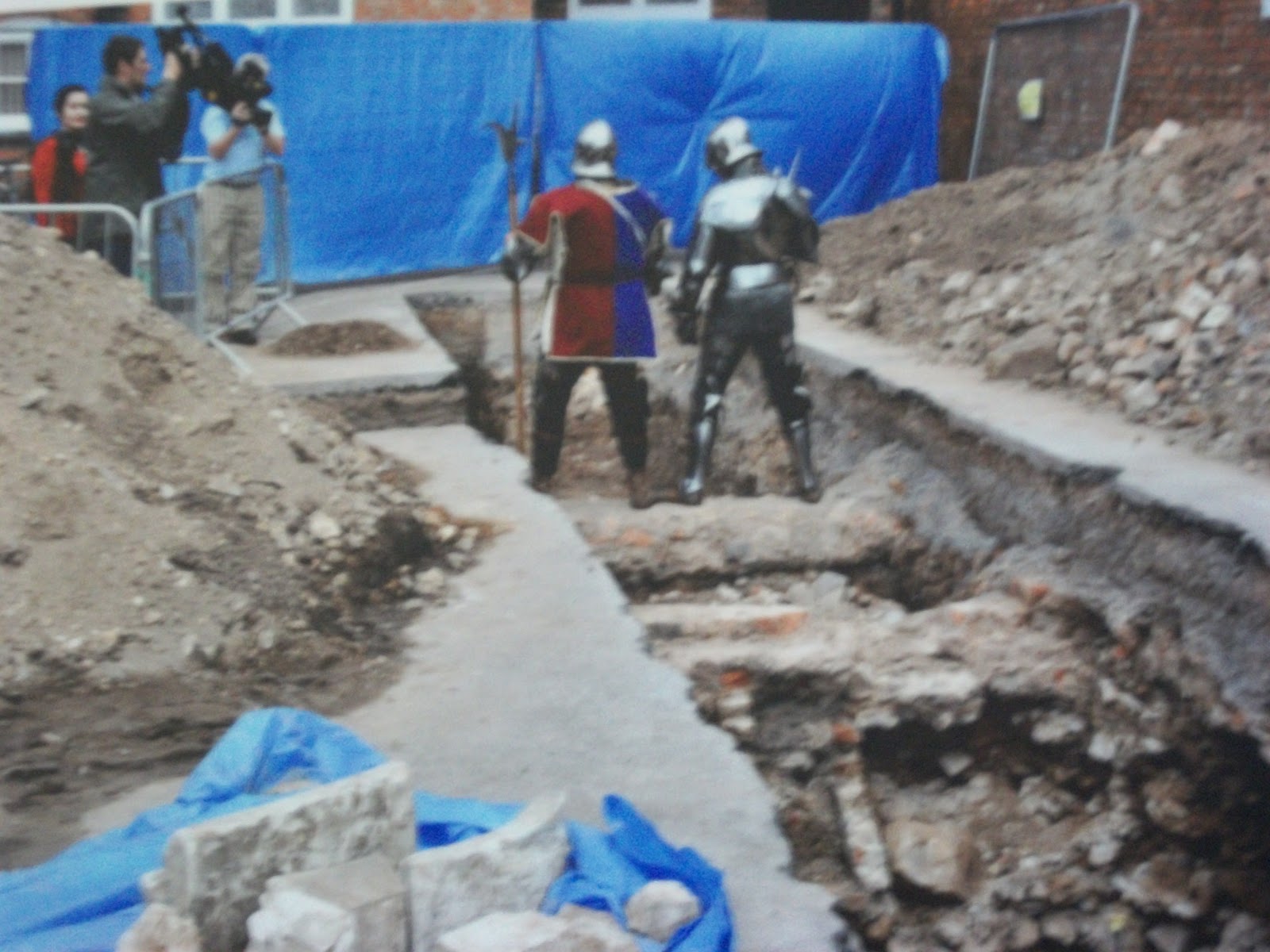
Anyway, just a month ago, a team from the university was excavating three trenches in the area around the cathedral where the Greyfriars Abbey used to stand and made a stunning discovery, a skeleton of an adult male with spinal curvature, evidence of a very nasty knock on the head, and an arrowhead in his back. Richard is known to have been buried in the Greyfriars Abbey after he was killed at the battle of Bosworth in August 1485, losing to Henry Tudor who then became Henry VII and was the father of Henry VIII, he of the six wives and the Henrician Reformation fame. This is a pic of the trench--in a parking lot no less--one of three dug by the team, with a couple of actors being filmed in it last month.


Now it looks like this again!


Anyway, exciting work being done on the remains including DNA analysis. Time will tell. The trench is literally just across the street from St. Mark's church, the core of which dates from the Conquest, and which was elevated to cathedral status in 1926 when Leicester was made a diocese--gotta have some place for "The Bish" to hang his mitre--but it is one of the smallest in England.


Walked to the cathedral gate that said "Entrance," went through and tried to open the door only to crash a ceremony underway in the nave elevating some new members of the clergy. So, thought I'd take in the Guildhall next door which dates from the early 15th century only to crash a wedding there, well not quite. The hall was closed but I only had to wait about ten minutes before the wedding was over and the place was open to visitors again. The first pic is of the outside of the building and the second is of the hall inside.


Not as grand as Commencement (where your blogster was wed), but not a bad setting for nuptials.

The highlight of the day, however, came at the Jewry Wall Museum a few hundred yards away. If you guessed that this may have had something to do with the town's Jewish population prior to the expulsion of all Jews from the kingdom by Edward I, Hammer of the Scots (and the Welsh), in 1290, you would be WRONG. Has no connection to anything Jewish apparently. Instead it is the site of the Roman bathes in the city which were dedicated to Juno (or Janus) and the Jewry spelling only dates from Victorian era. The "cester" in Leicester marks it as a Roman town (see earlier posts), but even before the Romans, there was a Celtic town there, as well as an Anglo-Saxon settlement later, and it became one of the five "county" capitals of the Danelaw in the 10th century. The baths were unearthed in the 19th century as were a number of villas with elaborate mosaic tile floors and fresco walls. Couldn't take any pics of the villa interiors in the museum (an excellent one by the way), but you can see the layout of the baths in this picture with the entrance in the back, preparatory rooms in the middle, and three "hot" baths in the foreground where the father and his daughter are reading one of the plaques.


After all this, a well deserved pint and sandwich and then back to Harlaxton for a relaxing evening.

Thursday, October 11, 2012

Music and Theatre at Harlaxton

First, in the "It's a Small World After All, Bethany Edition" category, was going into Grantham yesterday on the shuttle and got to talking with a visitor from Winston-Salem State University who had given a couple of guest lectures here this week and is looking to set up the program at his school. Turns out he is the son of Dr. Barry Richardson, former Econ prof and Dean of the Faculty at Bethany College from the late 60s. He lived on Point Breeze Drive when he was a boy, and we had an excellent visit recalling Bethanians from that era. Amazing how so many interesting people have dwelt along the banks of the Old Buffalo over the years and the extraordinary places that you run into them!

Then, in the evening, we had the pleasure of participating in "Death, Damnation, and British Studies, A Performance by the Harlaxton Choir and Players."


Sorry for the quality of the pix of the program, but forgot and folded it up before taking the picture. The evening featured the Harlaxton Choir of some 30 singers, including yours truly in his formal debut in the Bass section--seriously, and led by Visiting Professor James Larner of Marian University. Dr. Larner chose works that were linked to the themes or contexts of the British Studies program which all students take and included Gregorian chant (Dies Irae), early polyphonic music (Sumer is icumen in), and a contemporary arrangement of a traditional English melody (Autumn's Treasure). We also performed a couple of songs written by Dr. Kay Gandy, another Visiting Professor, the Sorting Hat Song, and a wonderful sendup of the British Studies class. We sang in the Great Hall here in the Manor which has acoustics comparable to Commencement Hall, although on a smaller scale.


The evening also featured an abridged version of "The Summoning of Everyman," acted and directed by students. In addition, Dr. Larner and two students presented a lovely flute trio by an English composer from the Hundred Years War era, John Dunstable, and a another student did a wonderful job with Dido's Lament by Purcell, a 17th century English composer. We ensured a standing ovation by ending with God Save the Queen. When in Rome. . . ! The point is that you don't have to give up music or theatre while you are studying here for a semester, so I would encourage students to consider that as well when thinking about coming here.

Finally, a tinge of sadness in the evening though. It was Stephanie's last night here. She was off to Heathrow this morning at 6:30 a.m. Will miss her desperately for the next 8 weeks.

Monday, October 8, 2012

A Splendid Weekend at the Coast

Well, campers, we spent last weekend at the seaside town of Whitstable on the Kent coast about 5 miles from Canterbury. It sits at the entrance of the Thames Estuary and for centuries has played a role in the maritime life of the area, as well as being a center of the oyster trade. In more recent times, it has been a vacation spot for Londoners as it is only about 75 minutes from Victoria Station by train. We arrived late Friday afternoon to deteriorating weather which turned even nastier in the night. However, by morning it was gloriously sunny and remained so for both Saturday and Sunday allowing us to walk along the sea wall and beaches for hours in the most beautiful weather. Our hotel, the Hotel Continental, was a typical 19th century seaside building with a lovely view of the sea. Our room was in the upper left corner.


Americans sometimes have trouble understanding that "beaches" in England are not like those in the US. For starters, there is little or no sand, instead these are rock beaches with quite substantial tidal flats that reach out into the sea a good way at low tide.


Second, this is the North Sea, so the water is about 45 degrees making for very chilly swimming--if you are foolish enough to try it. Instead, a typical day at the beach includes long walks along the sea wall and perhaps renting (or purchasing) a beach shack like this one to pile into in the event of bad weather.


A walk down into the harbor of Whitstable itself took us past rows of small artisan shops and the masts of the Whitstable Yacht Club--mostly small sailing boats or catamarans.


High Street had many small shops for art work, antiques, etc., a classic 19th century arcade, and, of course, numerous pubs and fish and chips shops. We had a wonderful example of the last at Ossie's Fish and Chips Shop just off the Marine Parade on our wanderings. A huge slab of fresh cod, battered and deep fried, with proper chips (what Americans call steak fries) on the side.

Again, could not believe our good fortune with the weather. We will long remember our stay.

Thursday, October 4, 2012

Burghley House Visit


Yesterday we went to Burghley House, named for William Cecil, the First Lord Burghley and chief minister to Good Queen Bess for the bulk of her reign, a spectacular example of the great country estates that began to dominate the English landscape in the reign of the Tudors. No longer castles or fortresses, these magnificent structures often started out using stone quarried from the local monastery which had been closed during Henry VIII's "reformation." The house is still the residence of the Earls of Exeter, but was converted to a trust in 1981.


Here is a view from the park surrounding the home. The wall in the foreground is called a Ha-Ha, I kid you not. It is invisible from the house and is actually one side of a sloped ditch which keeps the sheep and dear grazing in the park from approaching the house. Here is one of the fallow deer and one of our students in the car park being foolish.


The trip was organized for the Honors course here at Harlaxton by Dr. Edward Bujak, one of the permanent professors in the British Studies program, and faculty were invited to go along, so Steph and I joined in and are we ever glad we did. No photographs are permitted inside the house, so you will have to take my word for it when I say it is a visual delight. Room after room of the most exquisite paintings, tapestries, furniture, carvings and woodworking, etc., culminating in the the "Hell Staircase" that depicts the day of judgment and the descent into the nether regions. Pretty darn scary actually.

Outside, the grounds are immaculate and include several thousand acres of woodland and park. The park was designed by "Capability" Brown in the 18th century when all the rage was to destroy the original landscape around the great houses and completely redo them to look "natural"! So, this is a photo looking back at the house from the Lion Bridge which crosses the artificial lake.


And, of course,  we had to stop at the Orangery for tea and scones.


Tomorrow, we are off to Whitstable on the Kentish coast, so we will be probably not be posting again until early next week again.


Wednesday, October 3, 2012

London Trip Part Two

Well, last time we talked about our first day in London at the Eye, the theatre, and the Abbey. Friday we had to make some adjustments in our housing accommodations, but that was relatively easy to do--have to admit I do like computers for that sort of thing--and so we spent the afternoon doing more touristy things including visits to two of London's most famous retail outlets, Harrod's and Fortnum and Mason's. Harrod's is quite a trip, and I would recommend it just for the food stalls on the first floor if nothing else. Fabulous array of sweets, meats, pastries, teas, and what you will. We had to check out the pet shop department for Zoe and Clio but decided that they didn't need a $15 toy that they would just knock under the furniture anyway.

Fortnum and Mason's is a famous caterer going back to the 18th century that became legendary for its picnic hampers and such in the Victorian era. During World War I, they would deliver these directly to the troops (well the officers) in the front lines of France, guaranteed next day delivery with such delicacies as quail eggs, fresh strawberries, and the finest wines. Dr. Bill Young, long time chair of the History Department at Bethany, always talked about those hampers when I was travelling here in the 80s and 90s.

That evening, we took in a new play, "Yes, Prime Minister," written by the same team who produced the television show in the 1990s. The plot is pretty straightforward, a bungling politician who has made good all the while being manipulated by the permanent under secretary (i.e. career civil servant) and his earnest but naive staffer. The issues were updated to the latest political scandals, but the formula is timeless. Saw it at the Trafalgar Studios, a relatively new theatre. Had great seats, second row within three feet of the stage in a severely raked house.

Saturday was a day for museums. First to the Tate Britain, home of an extraordinary collection of JMW Turner paintings.


Unfortunately it doesn't photograph too well. However, the British Museum in Russell Square certainly does.


Free to the public, it houses a stunning collection of artifacts from the ancient world, as well as special exhibits, the current one being Shakespeare: Staging the World which we took in. More about the times than the author himself, it connects the themes of his plays with the political, economic, and cultural trends of Elizabethan England and the reign of the first Stuart, James I. It made a connection between James' treatise on witchcraft and the witches in Macbeth which had never occurred to me before, but then I never got to take Shakespeare with Mr. Taylor.

As you may be able to see, the weather Saturday was stunning for late September here, so we took advantage and just wandered around a bit. London is a great city for walking because 1) it is flat, and 2) there are beautiful little architecural or historical gems tucked away in practically every corner.

Sunday morning we checked out of the hotel and left our bags there and walked down to Hyde Park. Came into the park at Speaker's Corner, a tradition dating back to the 18th century. The corner is where anyone can get up on his soapbox--literally--and hold forth on the great issues of the day or the little ones depending on your point of view.


The chap on the left side of the fence is a student complaining about the rise in tuiton at university--until about 20 years ago, college was free in the UK-- and beyond him was a fellow preaching the superiority of the Koran. There was also a guy wearing a bloody spiked horn and two little devil's horns on his head, but I decided that was probably not for me.

From there we strolled down to the Serpentine, the lake in the center of the park, and did some  bird watching, including gray swans and white swans, ducks of various types, cormerants, gulls, and a variety of others.

 
A light lunch at the Lido on the south bank of the lake, followed by more ramblings through the park to the Speke memorial


Now, who was Speke, and let's not always see the same hands? Sir John Speke, right, noted explorer and first European to reach Lake Victoria in central Africa, as well as finding one of the two sources of the Nile. Got into a terrible row with his erstwhile fellow explorer Richard Burton--no not that Richard Burton--and died under somewhat mysterious circumstances in a hunting accident just before he was scheduled to debate Burton in London.

After that, a trip back to the hotel to get our luggage and off to Kings Cross/St. Pancreas to catch the train back to Harlaxton (well with a stop for a pint and some chips along the way.) All in all a most enjoyable weekend in the greatest city in the world.

Monday, October 1, 2012

London Trip Part One

We arrived in London on Thursday the 27th about 12:30 p.m. after a 80-minute trainride. One of the great things about being here is that you can get about anywhere in a reasonable amount of time either here or on the continent quickly and conveniently--there are a few exceptions. Distance is a completely different concept here than in the US. Everything is relatively close. In the time it would take you to drive to DC or New York, you can go from London to Edinburgh by rail. In the time it takes you to drive to Cleveland, you can be in Spain, Italy, Germany, Poland, you name it, by cheap air fare. It's a great opportunity.

Anyway, we did touristy things the first day, returning to the traditional haunts of Piccadilly Circus and Trafalgar Square. Here we are at the base of Nelson's Column.


Here is a relief of Nelson struck down by a dastardly French musketball at the moment of victory aboard his flagship HMS Victory.


And, of course, the statue of Eros in the center of Piccadilly with the giant electronic billboard behind.


Then it was on to the London Eye, one of the great abominations of all time, thank you very much Tony Blair--a ferris wheel in the south bank of the Thames, not far from Westminster Bridge. But, someone wanted to check it out, so we did. It is the most visited tourist attraction in Great Britain. 


I'll admit that the views were nice, but really, a ferris wheel in the middle of London? You can see the iconic Dome of St. Paul's through the buildings to one side, and the houses of Parliament to the the other, but really, a ferris wheel in the middle of London?


After that, a stroll along the Thames to Westminster Bridge and over to the Abbey for Evensong. I try to attend this whenever I'm in London in tribute to my mentor and friend Dr. David Judy whom so many of you knew. David was the man who insisted that I go to England during J-Term of my senior year which triggered my wanderlust that continues to this day. The last time I was here was with some students on our way to The Gambia, including Jack Wheeler, Paul Starcher, and Dex Myers, among others.

Then it was off to the theatre for a performance of Wicked, celebrating its sixth birthday on the stage in London that night. The Half-Price booth in Leicester Square has now morphed into a whole string of half-price (or so they say) outlets in and around that area, so you can still get excellent seats for a decent price, but it is nothing like the good old days--for example back in 1974 I was able to see Maggie Smith, Vanessa Redgrave, Alec Guinness and a host of other well known actors for about a pound a show, often less than that--but still a bargain compared to New York.

Enough for now. I'll post again soon about our Friday and Saturday, including trips to the Tate, the British Museum, and to another show.